Four Ways to Trick Your Kids Into Telling You About Their Day

Maintaining an open dialogue with our children is a priority, but it’s not always easy to get information out of them. The older they get, the more likely they are to give you an exasperated shrug in response to your “How was your day”-type questions. If you have a particularly chatty child, you may even get them to give you some kind of one-word response like “Fine” or “Whatever.”

But, there are some clever ways around the silent treatment.

In my nearly 14 years of parenting two oftentimes-uncommunicative boys, I have a developed a few tricks that have proven extremely effective in getting them to open up and actively engage in conversation with me — and without realizing that that’s what they’re doing.

Read more here.

A Double-Date With My Ex-Husband Brought Clarity, Not Complete Awkwardness

Man and woman with diverging line of footprints

Last Saturday, I went on a double date…with my ex-husband. Okay, it wasn’t exactly a double date, it was my 14-year old son’s birthday party. But for all intents and purposes, it was a double date.

Picture this: we’re in Buffalo Wild Wings with eight teenage boys at one table (wanting nothing to do with the accompanying adults), and my ex-husband, his live-in girlfriend, my boyfriend, and me at the next table.

The four of us sat there for two hours, laughing, joking, and chatting like we were couples who’ve been friends for years. Only, two of us sitting across the table from one another, each cozied up to someone new, were once married. To each other. For 15 years.

My ex-husband lost interest in me long before our marriage officially ended. I probably should’ve seen the divorce coming but I didn’t. When he informed me of his intentions to leave, I was blindsided. Within weeks, he was gone.

I was angry, sad, and confused. My heart was shattered as was my ego, and I hit bottom. I hung out there for a while – in the fetal position rocking back and forth. But here’s the thing about the bottom, once you’re there, there’s nowhere to go but up.

Little by little, I rebuilt myself, and as I did, I had an epiphany: the marriage really hadn’t been serving me in any meaningful way either. I’d been settling for a long time and I deserved better.

From this place of healing, the anger subsided, the pain eased, and I began to feel strong, whole, and secure in my own skin. With a sense of inner peace, I was able to move forward in life and love. I was also able to forgive my ex-husband for nearly breaking me. This was a critical building block to the friendly and productive co-parenting relationship we share today.

As we sat around the table noshing on wings and making friendly small talk, I unemotionally watched the man I once vowed “till death do us part” show loving affection to his new partner. That’s when it hit it me: maybe it wasn’t just me who was settling in the marriage, maybe he’d been, too. Maybe he, like me, deserved better. He was the one who chose to leave the marriage, so naturally, I made myself the victim. He was the bad guy, I was the good guy, and that was that. But possibly, I wondered, could he have been a victim, too?

He was animated and almost youthful in his interactions with her – playful, light, and doting. I hadn’t seen that side of him in years. He looked happy. He is happy! He wasn’t happy with me, but he clearly is with her. Let’s face it, had I been meeting his needs in a meaningful way, he would’ve paid more attention to me and showed me the loving affection I was watching him show to her.

I turned to the man sitting to my right, the true love of my life, and locked eyes with him. In that moment, I felt so completely content. It was abundantly clear to me that the four of us, all ex-spouses to someone, were exactly where we were meant to be.

Marriages go south, blame is placed, and hearts are broken. But at the end of the day, we’re all human. We all want to be loved, and feel needed, and have certain needs of our own met. Sometimes you just can’t find that in the person you married. Sometimes it takes a failed marriage, some crippling soul searching, and a new start to see that.

Three years after my divorce, I’m proud of the relationship I have with my ex-husband, and I’m thrilled that our extended circle can peacefully co-exist on a friendly level. Is it a little weird for ex-spouses and their dates to enjoy lighthearted conversation on a pseudo double date? Sure. But how great is it that we’re all weird enough to do so?

20 Ways to Show Your Kids You Love Them Without Saying the Words

As a mom, I find that I often beat myself up over something that I’m doing wrong or not doing well enough in the raising of my children. But then I remind myself that I am not today, nor will I ever be, perfect; I am flawed in so many ways I’ve lost count. And that’s okay.

But one thing I know for sure: my boys know, without a doubt, how much I love them. In that simple fact, I am confident. So today I am sharing with you my advice for how to show your kids you love them (without saying the words):

  1. Ask them about their day, every day.
  2. When they’re telling you something they deem important, give them your undivided attention.
  3. When they’ve done something that makes you proud, tell them.
  4. Make it a point to frequently remind them of all their good qualities.
  5. Take time to engage in one-on-one activities with them.
  6. Tell them how lucky you feel to be their mom.
  7. Laugh with them.
  8. Attend their extra-cariccular actives (sporting events, dance recitals, plays, etc…) as often as you can.
  9. Set boundaries.
  10. Encourage them to try harder while acknowledging what they’ve already accomplished.
  11. When you’re wrong, say I’m sorry.
  12. Respect their feelings.
  13. Be aware of what’s going on with their schoolwork: know when they have projects due or tests coming up; have  a sense for what they’re working on for homework; have a relationship with their teachers.
  14. Don’t talk down to them. They may be little, but they’re still human.
  15. Know who their friends are—and ask about them often.
  16. Let them into your world; open up to them (when appropriate).
  17. Ask for their opinion.
  18. Forgive them for their mistakes. Remind them that you also make mistakes.
  19. Look them in the eyes when you speak to them. (This is not always possible, I know. But do it as often as you can).
  20. Hug them. Kiss them.

5 Things We Can Learn From Our Children

Children. They’re young and green and unwise to the ways of the world. As parents, our job is to teach them and guide them and make sure they’re doing it all right. We know it all and they know nothing… right?

Maybe not.

Is it possible they have a thing or two to teach us? Is it possible that their innocence and zest for life gives them a perspective that we jaded adults may have lost?

I believe yes. I believe that if we open our eyes to it, we will find there is much we can learn from our children:

Make play a priority. Kids. Work. Chores. Adulthood is filled with a myriad of all-consuming responsibilities that make up the bulk of our everyday lives. And through the fog of the monotony, how easy is to forget to have fun? Easy, if you ask me. But that doesn’t make it right. My kids plan their day around time for play. Take a random Saturday in the Fall, for example. They’ll do what needs to be done—be it homework, chores, soccer games or whatever else may be on the agenda. Once done, they head out into the sunshine, rally their friends and play their little hearts out until the sun goes down. Do we do that? Once we’re done with our most pressing obligations—after the workday is over or after that last load of laundry is folded and neatly put away—do we find time to play? Or do we simply set our sights on the next job that needs to get done? For many people, it’s the latter. Play. It’s good for the psyche and the soul.

Learn. When our kids get up and go to school, how are they spending their day? They’re learning, right? Every day, they learn new skills in math, science, reading and social studies, among other things. They have their pens and paper to take notes and they’re given homework to reinforce the lessons of the day. Our kids spend the majority of their young lives learning. Do we do the same? Do we approach each day with a willingness to learn? We should. How awesome is it to acquire new knowledge? Today, for example, I learned that if the batter swings and misses for the third strike but the catcher doesn’t catch the ball, the batter can run to 1st. Who knew?  I also learned that kale contains 10% of the RDA of Omega 3 fatty acids. These are two things I didn’t know yesterday. So ask questions. Read. Talk to people. Maybe even pick up a new skill. Find little ways throughout life to learn—the opportunities all around us; They are innumerable. So do what your kids are doing every day: learn.

Make new friends. Extroverted in nature, both of my children make friends wherever they go—be it at school, in sports or even around town. My children rarely find themselves without somebody (or many somebodies) to play with. But making friends doesn’t seem to come as easily to us adults. In fact, it can be downright daunting. It requires us to step out of our comfort zones and put ourselves out there. Wouldn’t it be easier to just stick with the friends we have and call it a day? Wouldn’t it feel safer to stay within the confines of our already-established relationships? Sure. But where’s the fun in that? Each and every one of my friends contributes something significant to my life. Why wouldn’t I want to add to that wealth? Why wouldn’t we all want that? Take a risk. Branch out. Be like your kids and go make a new friend.

Cry when it hurts. Children cry. When they are hurt or sad, that’s what they do: cry. As parents, we seem to be programmed to think this is a bad thing. But is it really? Okay, the seemingly never-ending and often futile exercise of consoling one child or another can be a little frustrating for us as parents. But what our kids are doing is releasing their emotions in a normal, healthy way. We, on the other hand, are conditioned to suck back the tears. We are inclined to keep our emotions to ourselves, as we bottle up our fears, disappointments and pain. How healthy is that? Maybe our kids have it right in letting it all out. Of course I’m not suggesting we walk around whining and crying every time something feels crappy. But maybe if we can open up a little bit more and shed a tear or two once in a while, we can release some of our emotional turbulence and find a place of greater emotional, physical and spiritual well being.

Pour your heart and soul into the present moment. Ever watch your kids play? Ever notice how passionately engaged they are in the activity at hand? When I watch my kids play kickball with their friends, they’re playing kickball. 100%. They’re not thinking about the bath they need to take later or the homework they’ll likely be assigned tomorrow. They’re not beating themselves over the strike out in yesterday’s game or the fight they had with mom over this morning’s breakfast. No. What they are doing is living fully and happily in the present moment, savoring the experience with every fiber of their being. Let’s take a page from their book. Let’s find peace in the knowledge that life happens in the present moment—not in the yesterdays or the tomorrows. “Happiness, not in another place but this place…not for another hour, but this hour.” ― Walt Whitman

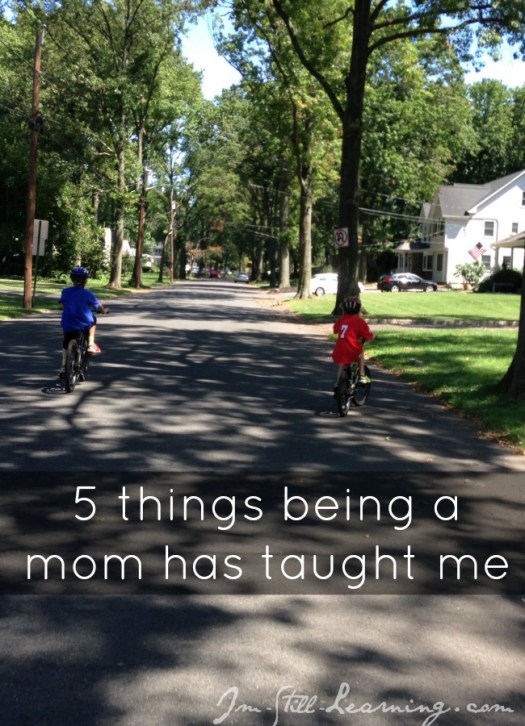
Five Things Being a Mom Has Taught Me

5Things.jpg

Report cards came home a few weeks ago. I always look forward to report card time—seeing how my kids are progressing, where they’re excelling, where they’re struggling and so on. Report cards give me a glimpse into what they’re doing for six hours each day when they’re not with me.

Each marking period as I glance over their grades, I am reminded of just how much boys are learning and growing every day. Their little minds are constantly being infused with new and exciting nuggets of information. And it got me to thinking: What about me? What about my report card? What have I learned and how have I grown? What nuggets of information have I gathered in my own adult-sized noggin?

As I sit here just weeks after my 40th birthday, I find myself in a place of reflection. I’m looking back on my life in attempt to generate my own progress report. And in doing so, it occurred to me that so much of what I’ve learned over the course of my adult life has come in the way of motherhood.

I’m not talking about the overt skills I’ve learned like how to change a diaper, how to nurse a sick kid back to health or how to adjust a palate expander. I’m talking about the intangibles—the more profound lessons that motherhood has to offer.

Sometimes we break, but we also heal. Last year, my son broke his thumb—in two spots. And oh how upsetting it was. His hand was purple, swollen and throbbing. He had to wear a splint for a month. He had to sit out of gym class, basketball and TaekwonDo for a month. He couldn’t rough house with his brother or jump off his top bunk for a month. He was an unhappy camper… for a month. But of course his body’s natural healing mechanisms kicked into gear and before he knew it, his thumb was good as new. His bone fused and he was back to living his active life once again.

Isn’t that true of our emotions, too? We sometimes break into what feels like irreparable pieces. But our minds, like our bones, have a wondrous capacity to heal. Life ebbs and flows. Sometimes we’re at the top of our game while other times we’re sniffing rock bottom. But the whole of who we are at our core wants to heal. Our healing powers that reside deep within are always working and fighting to keep us going—be it a broken thumb or a broken spirit. Sometimes we break, but we also heal.

Mess is unavoidable. Roll with it. I hate disorder; it stresses me out. But as a parent of two nutty boys, living in chaos is the norm. On any given day, my home looks like a scene from animal house, my car looks like a locker room and my purse looks like a trash compactor.

After years of fighting the uphill battle—working tirelessly to bring order to the overwhelming disorder—I’ve finally resigned myself to the fact that, as a mother, mess simply surrounds me. Rather than working myself to the bone trying to keep everything in line, I’ve learned to let go and just roll it. So the sink is full of dishes. So what? Is it gonna kill me to let those dishes sit while I play with my kids or watch an episode of Modern Family? Will I just crumble and die if I walk past the overflowing hamper of dirty laundry on my way out to lunch with a friend? Na. I’ve come to accept the fact that there will always be some mess somewhere calling out for my attention. But who cares? Why not enjoy life more and clean less?

Flexibility is essential. I’ve always had somewhat of a rigid personality; when things don’t go as planned, I become uneasy. Uncomfortable. Antsy. Flexibility has never been my strong suit. (Just ask my husband.) But life with kids requires flexibility—no ifsands or buts about it. Children are such unpredictable little things; they’ll throw a wrench into the best laid plans. Think of that fever that delayed the much anticipated summer vacation or the temper tantrum that cut the shopping trip short. We had to be flexible in those instances—there was simply no other choice.

Motherhood has trained me to take on a more flexible attitude. I have learned to harness the more adaptive side of myself and look at those unexpected situations with a let’s-make-the-most-of-it perspective rather than a why-oh-why-did-it-have-to-go-this-way? perspective. The end result: a happier, less rigid me.

Let go of control. I am a control freak—which is no doubt largely related to my aforementioned flexibility issues. When my kids were first born, I was in my glory; I had complete control over the little buggers. I was in charge of what they ate, what they watched and who they played with. I controlled their bedtimes, their bath times and their outfits. I, and I alone, was the decision maker of everything having to do with them. Sure my husband was right there beside me, but he knew better than to get in my way.

As my kids have grown, I’ve had to give up so much of the control I enjoyed during their early years. At 9 and 11, my boys have learned to think for themselves. Do I love every single friend they have or article of clothing they don? No, but I do respect their choices. Do I worry about them when they’re not in my care? Sure do! But at the end of the day, I have to let go and, to some degree at least, have faith in the decisions they make. This has been a tough lesson to internalize—but it is one that I now challenge myself to apply to all aspects of my life. I can’t control all that surrounds me—or even most of what surrounds me. I can only control my reactions. Being a mom has helped me to accept this fact.

Accept disappointment as a part of life.  Last week, my son found out he didn’t make the “A” travel baseball team for Spring. It was a massive disappointment, given all the time and effort he’d put into his training. He had been feeling pretty confident he’d make the team and was devastated when he learned he did not. But once the knee-jerk reaction of disappointment subsided, I reminded my son (and myself, for that matter) that disappointment is an inescapable aspect of life. Nobody likes it, but everybody experiences it. I urged him to use this disappointment to push him harder towards his ultimate goal: playing competitive baseball.

I have this conversation with my kids often, as there’s always something that pops up in their lives that lets the wind out of their sails—be it a team they didn’t make, a grade they weren’t expecting to get or a birthday party they thought they’d be invited to. And each time I do, the conversation serves as a reminder to myself as well. I have been passed over many times for a myriad of different opportunities. But now, rather than hiding my head in shame, I remember that we are all human; we all feel deflated at times. With each disappointment, I remind my kids and myself that there is a reason for it. The disappointments of life are mere stepping stones on our journey to that something greater. This is true for each and every one of us.

Life is one big classroom. I will continue to keep my eyes open to the lessons this life of mine has to teach me.

Do You Always Love Me?

Do-you-always-love-me

Last week while tucking my 11-year old into bed, he asked me: “mom, do you always love me?”

I was taken aback. “What do you mean, ‘do I always love you?’” I asked.

“I mean, when I do something bad or when you’re really, really mad at me, do you still love me then? I mean, are there ever times when you don’t love me?” he asked.

I couldn’t even believe my ears.

“There has never been a time when I haven’t loved you—nor will there ever be,” I said.

“Okay, what if I go to jail one day… even then?” he asked.

“Even then!” I answered. “I will love you no matter what you do or where you end up. Even if it’s jail—which, by the way, I’m confident will not be the case. But that doesn’t mean I’ll always love your actions. There’s a big difference,” I explained.

“Okay, cause you were pretty mad at me before. I thought maybe you stopped loving me for a minute,” he said.

In that moment, it occurred to me that even though I’m usually pretty overt about my love for my kids, they may need additional reinforcement during those times when we’re arguing. Especially during those times when we’re arguing.

“Don’t be cray cray,” I said. “I love you and your brother more than life itself. Yes, I was pretty angry before; I wasn’t in love with your actions— but I am in love with you, always. [silent pause] Okay?”

“Okay.”

We kissed goodnight. He went to sleep and I went into reflection. And from that moment on, I vowed to end every argument with my children with the following words: “Remember, no matter how angry I get, I will always love you. Got it?”

Our kids may act tough, sometimes—but inside, they just want to know that they are loved. We all do.

20 Reminders for my Growing Boys

20Reminders_3

  1. Always hold the door for others—especially girls.
  2. Don’t let anyone boss you around. You are your own person.
  3. Admit when you’re wrong and say you’re sorry.
  4. Remember, God is always watching.
  5. Make eye contact.
  6. Before you judge others, put yourself in their shoes.
  7. Don’t be afraid to fail. It’s how we learn.
  8. Your actions have consequences.
  9. Remember that even when you mess up, you are still very much loved!
  10. If someone treats you badly, walk away.
  11. Clean up after yourself.
  12. You can’t be good at everything. Embrace that fact.
  13. Always give thanks—even when things aren’t going your way.
  14. Make lots of friends.
  15. Listen when others speak to you. Don’t just hear them—listen.
  16. When you’re upset, don’t keep it in. Talk about it.
  17. Always give a thank you wave when someone lets you go in traffic.
  18. Tell the truth, even if you think it might get you in trouble. Honesty builds character.
  19. Be dependable. Keep your word. Be someone others can count on.
  20. Your family is your safe haven… your support system. Come to us with anything.

Ages and Stages: Off to Middle School

My oldest boy has been in the 5th grade for three months now—and it’s been quite an adjustment.

For me.

Yes, he’s doing great—thriving, in fact: making friends, learning his way around his new school and just generally having a blast. But it’s a confusing time.

For me.

Most of the time, he’s still my little boy: He sleeps with stuffed animals and the blanket grandma made him when he was a baby. He loves a good game of Candy Land. He would always rather sleep with his mama than in his own bed. And yes, still holds my hand and says I love you in public.

But…

He is growing taller (up past my shoulder now). He’s losing some of his innocence and becoming wiser to the ways of the world. He’s starting to care about his appearance and having private conversations with his friends. And I’m still not used to the fact that he now goes to school with kids who look like they could be in college.

It’s a whole new world.

For me.

I’m struggling with how I feel about it all: I want him to stay tiny and adorable, yet I’m having a blast watching him sprout. I long to keep him in a place of blind innocence, yet I enjoy the newfound substance of our conversations. I miss being able to hold him on my hip, yet there is nothing in the world that compares to his giant bear hugs.

What can I do? How can I deal with the continuous cycle of change that goes along with growing children? I’ve already discovered that I am powerless to turn back the hands of time (not for lack of trying, I might add).

That leaves me with only one choice: Sit back and enjoy the ride as I watch my children grow.

Each passing year brings with it a new stage in their lives—and mine. Am I ready for it? Probably not. But this is parenthood—at its best.

Being in the Now With My Boys

Dman

Last night, my husband had to unexpectedly go out of town. Though I don’t necessarily enjoy when he travels, I do find that it gives me more of an opportunity to bond with my kids—particularly when he’s gone over the weekend. When my husband is away, I make more of a deliberate effort (for whatever reason) to find activities to fill my time alone with the boys.

As soon as he left, I turned to the kiddos and said, “So, what should we do tonight?” I don’t know what it’s like in your house, but in mine, looms are all the rage. Yes, even my boys—3rd and 5th graders—are banging out those vibrant little bracelets like crazy. So I was not surprised to hear that they wanted to spend the night looming. But first, we’d need to go out and buy a few more packs of bands; their supply was running low.

Normally when my kids ask me if we can go out and buy something superfluous, I say no. But because I love the fact that they are currently more into working with their hands and their creative little brains than in mind-numbing video games, I was more than willing. We drove into town, grabbed six more bags of loom bands then headed across the street for a nice dinner. When we came home, we built a fire and got to work—all three of us. My 9yo, who is already counting down the days till Santa, put on some Christmas tunes to set the mood.

No TV. No video games. No arguing. (Okay, there was some arguing, but not as much as usual.)

It was a perfect night.

Yet, my mind was jumping all over the place. Rather than giving 100% to what I was doing with the boys, I found myself thinking about all the things that needed to get done:

I should really throw in a load of laundry.

The boys need to get in the shower soon.

Look at this mess!

I need to go food shopping tomorrow.

What am I making for Thanksgiving? 

After a while, I became aware of what I was doing. So I stopped. I reminded myself that moments like these—unplanned moments when everything just sort of comes together perfectly—are rare. With that thought, I was able to rein myself back in so that I could be fully present in the moment. I decided that I didn’t care about the mess or the laundry or the showers. I put my thoughts of food shopping and Thanksgiving dinner aside—and I brought myself back to my children.

It’s so easy to get caught up in to-do lists and the schedules of tomorrow and the mess around us. But when we do that, we miss out on the simple pleasures in life. Happiness comes from the nows of life, not the should-bes and could-bes and will-bes of life. This is a lesson that I have to continue to teach myself—and last night was yet another reminder of the simple joy that is living in the moment. And I learned how to make a zig-zag loom to boot!

The Santa Quandary

My oldest son is 10 and he believes in Santa.

But for how much longer?

It is one of those issues in parenting that nobody warns you about: when to admit that Santa’s not real.

This has been on my mind for the past two years. When my son was eight going on nine, my husband and I were certain he’d figure it out. He had too much common sense not to. He started asking questions like, “How does Santa fit in the chimney?” and “How can Santa possibly get to everybody’s house in one night?” We saw the wheels spinning in his little mind and were sure that by Christmas day, he’d see it was all a farce.

But somehow, we made it through two more Christmases without a hitch.

Now, he’s ten. He is in 5th grade. Middle school. No way will he be on board this year. No way!

Or will he?

Last night, out of nowhere he said to me, “Luke told me there’s no Santa…but obviously there is [silent pause] … right, mom?”

My mind raced: What do I say? Do I fess up? Come clean? Let him in on the secret? Is now the time? We’re alone in the car… now would be the perfect time.

But it was so clear to me in that moment that he really wanted to believe. So I immediately threw out the old standby line: “You’ve got to believe to receive, honey.”

“Yeah,” he said. “I need to get going on my list. What do I want this year?”

Conversation over.

But I felt horrible. Is he at that age now where it’s nothing more than a lie? He trusts me to be honest with him. And with everything else in life, I pretty much am. But I could hear in his voice that he just wasn’t ready to hear this particular truth.

And this wasn’t this first time he broached the topic with me. A few months ago, he told me about a conversation he’d had with another friend:

“Mom, Josh said that the mom and dad put the presents under the tree, not Santa. But I told him that’s not possible because my mom would never stay up till 12:00.”

At that time, all I could think to say was, “Seriously! My bed time is 10:00!”

So I began to wonder: Is he the only one who still believes? Am I setting him up for ridicule at school?

Unsure of the answer, I called a friend to see where her son, an 11-year-old who teeters on the precipice of puberty, stands on the matter. And to my delight, I discovered that her son had just asked his mom to mail his letter to Santa so it would get there early this year.

Okay, so mine is not the only one still hanging on. My boy will not, as I feared, be the laughing stock of the 5th grade.

But all night this weighed heavy on my mind. I pondered and I thought. I thought and I pondered. When is the right time to tell him? Is there ever a right time? What do I do about his friends who no longer believe?

Then I remembered a conversation I’d had a while back with a friend of mine who’s kids are now grown. She once told me that she’s never had the Santa’s-not-real conversation with their kids. No… she and her husband always told the kids that Santa lived in their hearts. As her kids grew, even through the teen years, the presents under the tree were from Santa. No one questioned it. No one complained.

With that idea in mind, I found comfort. By the end of the night, I concluded that I had responded to my son appropriately. I am not doing him a disservice by keeping him from the truth. I am keeping the magic alive in his world—something that he clearly craves.

Both of my boys will run into the know-it-all kids who feel the need to spill the beans. I cannot stop it or control it. All I can do is try to keep the spirit of Christmas going strong within the confines of my home.

Maybe the time will come—maybe even next week—when he will ask me that question and my gut will advise me to respond differently. But for now, we’re hanging on. For now, Santa is a part of our lives; He is part of our family; He is part of our Christmas.